
Wedding Flower Costs: What Couples Really Pay, by Region and Budget (Copy)
Planning your wedding flowers is one of the most exciting parts of creating your wedding day, but it can also be one of the most confusing. Over my years creating wedding flowers from bridal bouquets and ceremony arrangements to reception centrepieces and floral installations, the cost of wedding flowers varies enormously. Many couples begin planning with a rough figure in mind, only to discover that quotations can differ by thousands depending on the florist, location, season, flower varieties, and the scale of the design.
If you've searched online for "How much do wedding flowers cost?", you've probably found a wide range of answers. Some articles suggest a budget of a few hundred, while others recommend several thousand. The truth is that both can be correct. A small, intimate wedding using seasonal flowers requires a very different investment than a large celebration featuring premium blooms, elaborate floral installations, and bespoke designs.
This guide has been created to cut through the confusion. Rather than offering vague estimates, we'll explain what couples are actually paying in 2026 following online research, why costs vary so significantly, and how to build a realistic floral budget based on your wedding style, guest numbers, and location. We'll also explore regional price differences across the United States, the United Kingdom, Ireland, and other international markets, helping you understand what represents fair value wherever you're planning your wedding.
More importantly, we'll explain what many pricing guides leave out. Wedding flowers are not simply the cost of the stems. Every quotation reflects a combination of design expertise, sourcing, conditioning, preparation, transportation, installation, on-site labour, equipment, and the experience required to deliver flawless floral arrangements on one of the most important days of your life. Understanding these factors will help you compare quotations with greater confidence and avoid making decisions based solely on price.
Whether you're planning a relaxed countryside celebration, a luxury hotel wedding, a destination ceremony, or an elegant city reception, this guide will help you understand where your budget is likely to be spent, which elements have the greatest impact on cost, and where meaningful savings can be made without compromising the overall look and feel of your wedding.
Throughout this guide, you'll find practical advice, realistic price ranges, expert budgeting tips, and common mistakes to avoid. Our goal is simple: to give you the knowledge to make informed decisions, ask better questions, and invest your floral budget where it will have the greatest impact.
Why Trust Petal Brief?
Petal Brief is an independent wedding flower consultancy. We are not a florist, we do not sell flowers, and we don't benefit from recommending one supplier over another. Our role is to help couples understand their options, develop clear floral specifications, estimate realistic quantities, and compare florist quotations on a like-for-like basis.
That independent perspective means this guide is designed to educate first. Whether your floral budget is €1,500 or €25,000, understanding how wedding flowers are priced will help you plan with confidence, avoid costly surprises, and create beautiful floral designs that reflect your vision without unnecessary expense.
Wedding Flower Costs at a Glance
One of the first questions couples ask is, "How much should we budget for our wedding flowers?" It's a sensible question—but the answer depends on far more than a single number.
Your floral budget will be influenced by factors such as your wedding location, guest numbers, venue, flower choices, seasonality, and the overall style of celebration you're planning. A relaxed countryside wedding with seasonal flowers will naturally have a very different budget from a luxury ballroom reception featuring elaborate floral installations and premium imported blooms.
Rather than focusing on a single "average cost", it's more helpful to think about wedding flower budgets as a range. Most couples fall into one of three broad categories:
Budget LevelTypical Floral Investment Suitable For Essential €1,000–2,500
Intimate weddings, simple personal flowers, elegant ceremony styling: Classic €2,500–5,000
Most traditional weddings with ceremony flowers, reception centerpieces, and bridal party flowers: Premium €5,000–10,000+ Larger weddings, statement floral designs, premium flowers and enhanced venue styling
These planning ranges are intended as general guidance rather than fixed pricing. Depending on your country, venue, guest numbers and design aspirations, your budget may fall above or below these figures.
One of the biggest misconceptions about wedding flowers is that you're paying only for the blooms themselves. In reality, your florist is delivering a complete professional service that includes consultation, sourcing, flower conditioning, design, transportation, installation, on-site styling and, in many cases, post-event collection.
Throughout this guide, we'll explore how wedding flower costs vary around the world, what drives those costs, what you can realistically expect at different budget levels, and how to make informed decisions that maximise both value and visual impact.
-
From my experience couples initially focus on the cost of individual bouquets or centerpieces. In practice, the biggest influence on your overall floral budget is usually the complexity of the design, the amount of on-site installation required, and the time needed to create it. Understanding this difference can help you compare florist quotations more fairly and make informed decisions about where to invest your budget.
-
That most professional florists begin preparing your wedding flowers several days before the wedding, normally 3 to 4 days from my experience. Flowers are carefully conditioned, hydrated, trimmed and stored in temperature-controlled environments to ensure they look their best on the day.
-
Before deciding on your floral budget, create a list of the three floral elements that matter most to you. Whether it's a spectacular ceremony backdrop, luxurious reception tables, or an unforgettable bridal bouquet, prioritising these features helps you invest where they'll have the greatest visual impact.
Why Wedding Flower Costs Vary So Much
One of the biggest sources of confusion for couples planning their wedding is the enormous variation in flower prices. You may receive one quotation for €3,500 and another for €7,500, even though both appear to include similar arrangements. This often leads couples to question whether one florist is overcharging or whether the lower quotation is missing something.
The reality is that there is no universal price for wedding flowers. Every wedding is unique, and every florist approaches design, sourcing, staffing, and installation differently. Understanding what influences the final quotation is the first step towards comparing prices fairly and setting a realistic budget.
Several key factors determine the overall cost of your wedding flowers.
Your Wedding Location
Perhaps the single biggest influence on pricing is where your wedding takes place.
Florists working in major cities such as New York, London, Dublin, Sydney, Dubai, or Paris typically have higher operating costs than those serving smaller towns or rural areas. Rent, staffing, transport, storage, insurance, and supplier costs all contribute to higher quotations.
Destination weddings can introduce additional costs, including transporting flowers over longer distances, importing specialist blooms, or sourcing flowers through local wholesalers with different pricing structures.
The Time of Year
Flowers are seasonal, just like fresh fruit and vegetables.
When flowers are naturally in season, they are generally more abundant, easier to source, and often more affordable. Choosing flowers that are out of season may require international imports, increasing both cost and the risk of limited availability.
Seasonality also affects flower quality. Blooms grown naturally during their peak season often have stronger stems, richer colour, and better longevity than flowers imported from other parts of the world.
Your Choice of Flowers
Not all flowers are priced equally.
Garden roses, peonies, orchids, ranunculus and specialty blooms usually command higher prices than carnations, chrysanthemums, alstroemeria, lisianthus or many locally grown seasonal flowers.
However, the flower itself is only one part of the equation. A bouquet made entirely from premium flowers may require fewer stems than a larger bouquet designed using a carefully balanced mix of flowers and foliage, resulting in a similar visual impact at a lower overall cost.
Guest Numbers and Venue Size
The size of your wedding naturally influences your floral budget. (remember 8% - 10% of invitees will not make it)
More guests often mean more reception tables, additional centrepieces, larger ceremony spaces, and more decorative features throughout the venue.
Equally important is the venue itself. A grand ballroom with high ceilings may require larger floral installations to create visual balance, while a beautiful garden venue or historic building may need very little decoration because the surroundings already provide much of the atmosphere.
Design Complexity
Simple arrangements are generally quicker to prepare and install than bespoke floral designs.
Large floral arches, suspended installations, staircase displays, hanging arrangements, floral meadows, and custom-built structures require significant planning, specialist mechanics, additional staffing, and longer installation times. These designs can dramatically increase both labour requirements and overall costs, even when the flowers themselves remain relatively similar.
As a result, two weddings with comparable guest numbers and similar flower varieties can have substantially different budgets based solely on the complexity of the design, this is where Petal Brief can help.
Wedding Flower Costs by Country: What Couples Really Spend in 2026
If you've searched online for the average cost of wedding flowers, you've probably noticed that the figures vary considerably. One website may suggest a budget of €1,500, while another recommends €5,000 or more. So which figure is correct?
The simple answer is that they all can be.
Wedding flower budgets are influenced by far more than geography. Labour costs, local demand, venue style, flower availability, import requirements, and the scale of the floral design all play a significant role in determining what couples ultimately spend. That's why comparing your wedding to a single national average can often create unrealistic expectations.
Rather than treating the figures below as fixed prices, think of them as planning benchmarks. They provide a useful starting point for understanding how different markets compare, while recognising that every wedding is unique.
Understanding the Numbers
Before comparing countries, it's important to understand what these figures represent.
Unless otherwise stated, the budgets below refer to a full-service floral package for a wedding of approximately 80–120 guests. This would typically include:
Bridal bouquet
Bridesmaids' bouquets
Buttonholes and corsages
Ceremony flowers
Reception centrepieces
Head table flowers
Cake flowers
Delivery
Professional setup
Collection of hired items where applicable
They do not necessarily include large suspended installations, floral ceilings, elaborate flower walls, custom-built structures, extensive candle styling, furniture hire, or premium venue styling, all of which can substantially increase the overall investment.
Typical Wedding Flower Budgets by Region
The table below provides realistic planning benchmarks based on current industry guidance and market trends. These figures are intended to help establish expectations rather than provide fixed quotations.
RegionTypical Average Spend / Common Planning Range
🇺🇸 United StatesUS$2,800–3,500 / US$1,500–6,000
🇬🇧 United Kingdom£1,000–1,500 / £800–3,000
🇮🇪 Ireland €1,500–2,500 / €1,000–4,500
🇦🇺 Australia AU$3,000–6,000AU / $2,000–8,000
🇨🇦 CanadaCA $2,500–4,500CA / $1,500–7,000
🇦🇪 United Arab Emirates AED11,000–25,000 / AED8,000–40,000+
These figures are based on a combination of current wedding industry reports, florist pricing guides, and market observations. Your actual investment will depend on factors such as guest numbers, venue, flower selection, seasonality, and design complexity.
Looking Beyond the Average
One of the biggest mistakes couples make is comparing their wedding to a national average without considering the style of celebration they are planning.
For example, a couple hosting an intimate garden wedding for 50 guests may spend significantly less than the published average, while another couple planning a luxury ballroom wedding with floral arches, suspended installations, and premium imported blooms may invest several times more.
The average is useful because it provides context—but it should never define your budget.
Instead, ask yourself:
"What level of floral styling do we want our guests to experience?"
That question will almost always lead to a more meaningful budget than simply trying to match a published average.
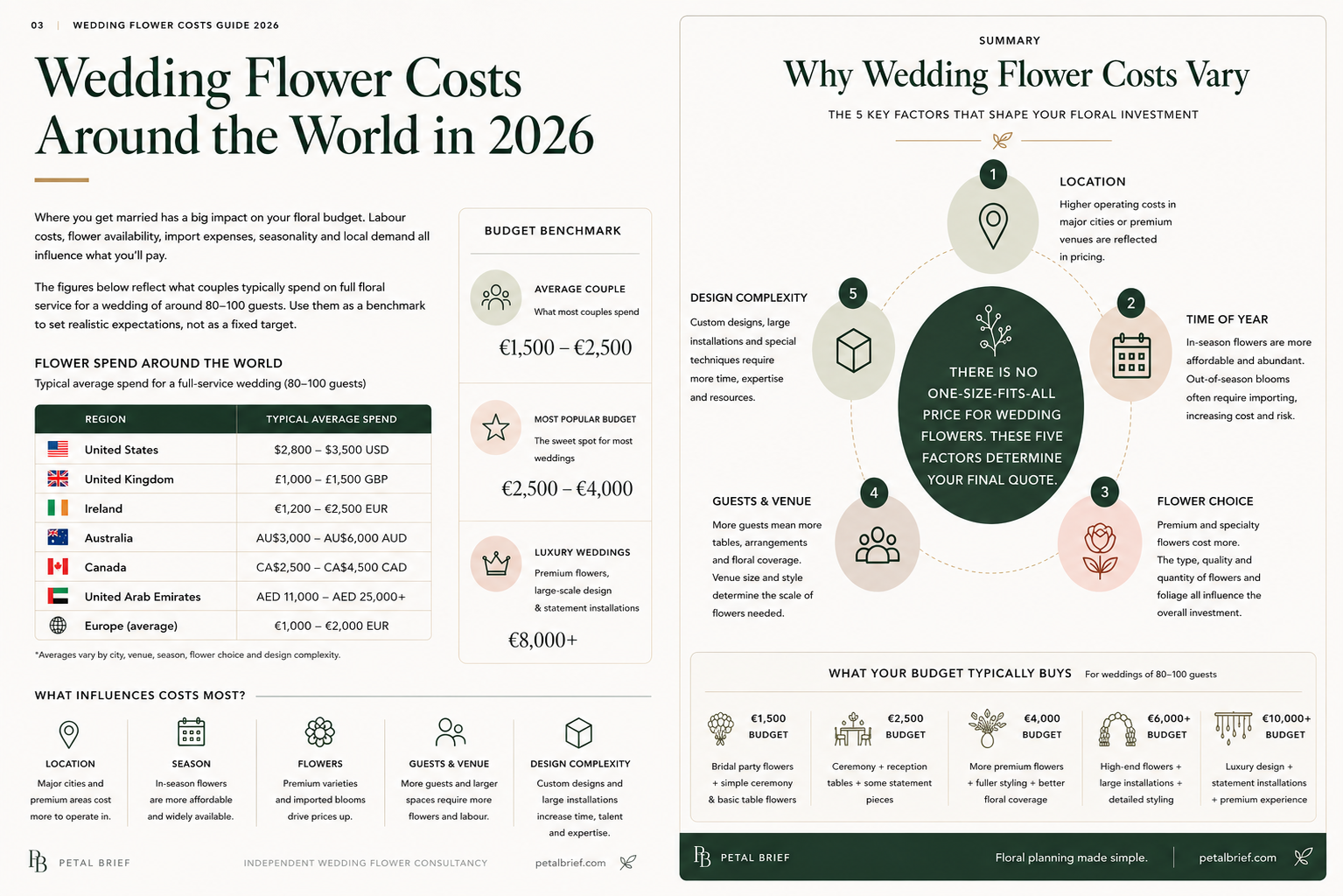
Figure PB-001 | Wedding Flower Costs by Country (2026)
What Does Your Wedding Flower Budget Actually Buy?
Once you've established a realistic budget, the next question is usually far more practical:
"What can we actually expect for our money?"
The answer depends on your wedding style, guest numbers, venue, flower choices, and whether you're planning a simple celebration or a highly styled event. However, understanding what different budget levels typically include can help you set realistic expectations before speaking with a florist. You dont need to understand all available just what you need, remember that.
It's important to remember that no two weddings are identical. A €3,000 floral budget may create a stunning result for an intimate countryside wedding, while the same budget may only provide essential arrangements for a large hotel ballroom. Rather than focusing solely on the amount you spend, I think about how your budget is allocated and where flowers will create the greatest visual impact.
The examples below illustrate what couples can typically expect from different levels of floral investment. They are intended as planning guidance rather than fixed packages and should be adapted to suit your own priorities and wedding style.
I have rounded the costs to nearest whole numbers, allowing for ± on either side of the quoted figures, I note also that centerpieces are not always required but prices jumb a little here because of this and the fact the florist has to come back the next day to collect the vases, again hidden costs.
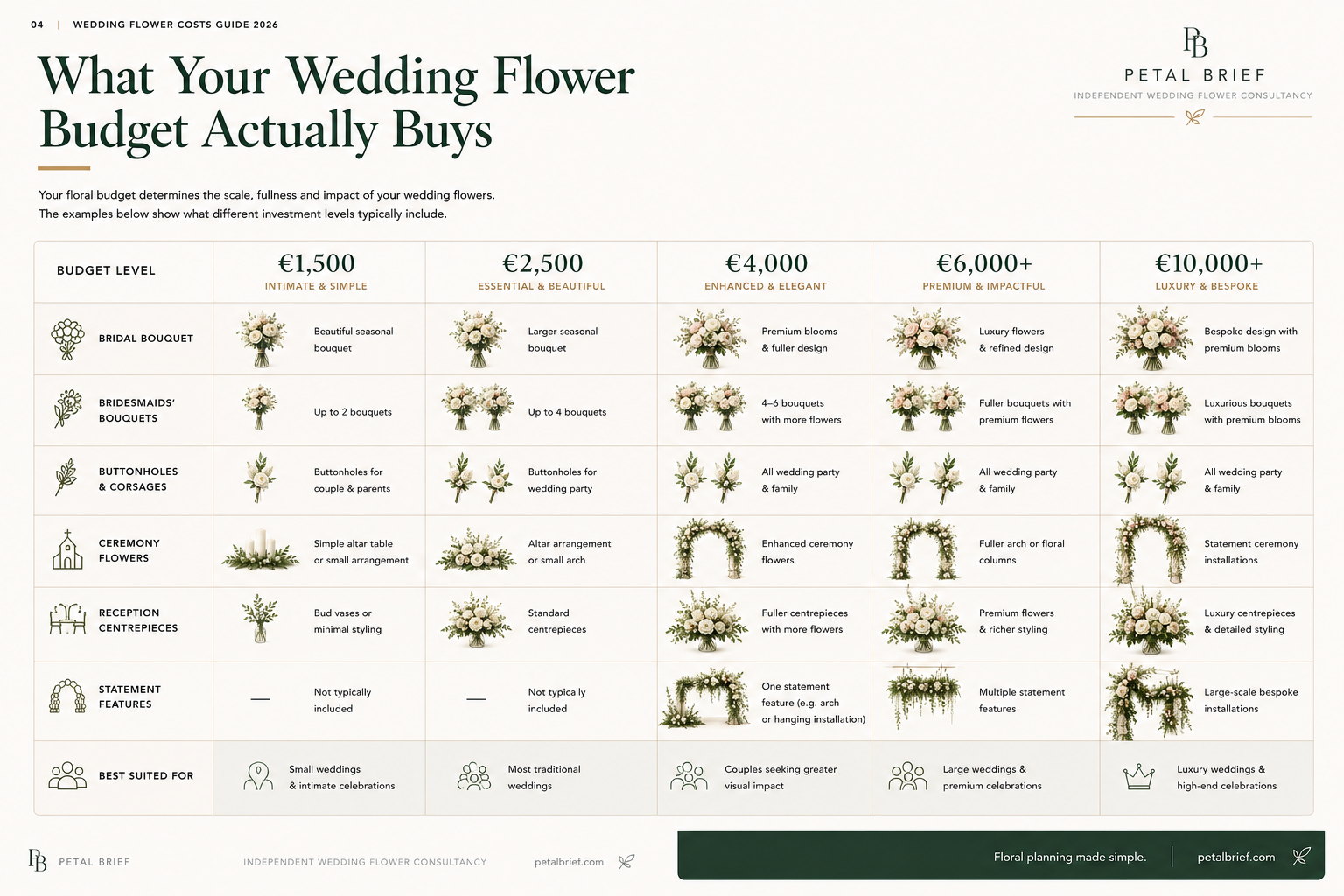
An illustrative comparison of what different wedding flower budgets can typically include. The examples shown are intended as planning guidance and will vary depending on location, guest numbers, venue, flower selection, seasonality, and design complexity.
The Hidden Costs You Should Know
In my experience working with couples, it’s often the unexpected costs that catch them off guard. One bride I worked with was surprised by the labor fees for moving ceremony arrangements to the reception. Another couple hadn’t factored in extra charges for a midnight breakdown of a large installation.
Common hidden costs can include extra delivery fees for remote venues, premium charges for out-of-season blooms, or last-minute design changes that require extra labor. Even something as simple as flower preservation after the event can add up. I always advise my couples to ask their florist to break down every service in detail—transparency prevents surprises.
By knowing these potential extras, you can budget smarter and ask the right questions from the start. In the end, it’s all about feeling in control of your floral budget, so you can focus on the day itself.
Smart Ways to Save Without Sacrificing Style
From my time working with couples, I’ve learned that you can absolutely have stunning flowers without overspending. One couple opted for a statement ceremony backdrop that we repurposed for their background behind the top table it was elegant and cost-effective. Another bride embraced seasonal flowers, which meant fresher blooms at a better price. I often suggest focusing on fewer, larger arrangements like a standout arch or impactful centerpieces rather than spreading the budget thin. And don’t underestimate the beauty of greenery, lush foliage can be just as striking as blooms. With thoughtful planning, you’ll have a gorgeous celebration without the stress of overspending, reuse is the name of the game but offset with a little labour cost to get this done.
Designing Your Vision with Petal Brief
When you partner with Petal Brief, our goal is to help you confidently shape your floral design before you even meet your florist. We’ll start by honing in on the atmosphere you want whether it’s timeless elegance, modern minimalism, or a vibrant celebration. We’ll guide you through mood boards, color palettes, and any meaningful personal touches you have in mind. By the time you present your brief to your florist, you’ll already have a thoughtfully curated design direction. We’re here to make sure you walk away with a plan that feels unmistakably yours one that reflects your vision and that you’ll feel excited handing over to your florist.
So Where are we now in July 2026, over the past year, wedding trends have shifted toward smaller guest lists with more impactful designs, including floor to ceiling décor and bold, moody color palettes. Couples are favoring rich tones and vintage aesthetics, while nature-inspired, intimate settings remain popular. With these trends, floral designs are focusing on impactful installations and seasonal blooms. Understanding these shifts can help couples align their floral plans with the latest styles. At the end of the day it always comes back to what you like, if you like it then you like it.
